Beekeeping in West Africa is closely linked to the climate, vegetation and behaviour of local honeybees. The conditions encountered by a beekeeper in The Gambia are very different from those found in Europe: a long dry season, a strongly seasonal availability of flowers, high temperatures, tropical pests and, importantly, African honeybees that can behave very differently from European strains.
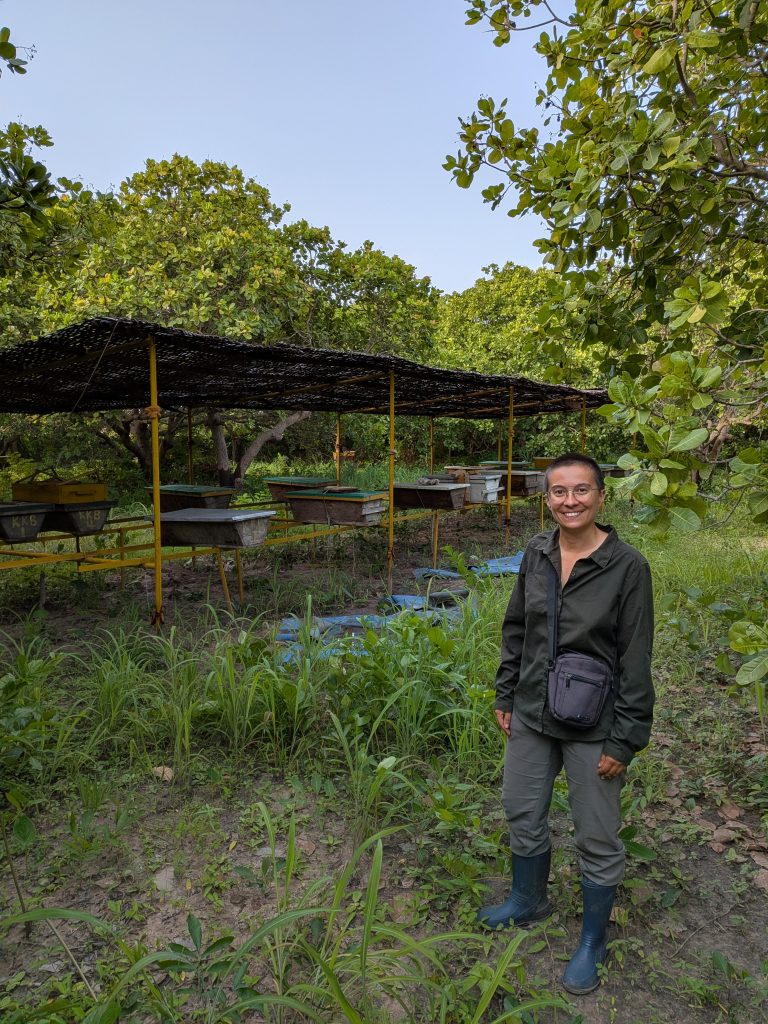
During our stay in The Gambia in August and September 2026, we had the opportunity to work directly on these challenges at Kankanba Farm, where around 150 beehives had been installed, including 100 Dadant hives and 50 Kenyan top-bar hives. With professional beekeeping training from IPEA La Reid in Belgium, Pauline was responsible for assessing and developing the apiary, adapting her technical knowledge to the local bees, climate and resources available on the farm. This work involved assessing the existing colonies and equipment, starting the first management work during the rainy (low) season, and developing a longer-term approach based on natural colony establishment, regular monitoring and staff training.
A climate that determines the beekeeping calendar
Across West Africa, rainfall generally decreases from the humid coastal regions towards the Sahel. In many areas, there is one main rainy season followed by a much longer dry season, but its duration varies considerably with latitude. In the Sahel, the rainy season can last only a few months, while coastal areas further south receive much more rainfall and may even have two distinct rainy periods.
This seasonality has a direct impact on bees. The availability of nectar and pollen is not constant throughout the year, and colony development tends to follow the availability of forage. In the savannah and Sudano-Sahelian regions, the dry season can correspond to the main honey-flow period, while the rainy season may coincide with a period of reduced forage availability.
The exact calendar should therefore not be copied from one country to another. A beekeeper should first understand the local flowering calendar: which plants provide nectar and pollen, when they flower, and what happens to the colonies immediately afterwards.
This is particularly important in The Gambia. At Kankanba Farm, for example, the farm’s mango, cashew and citrus trees form an important part of the agricultural environment around the apiary. These trees and other surrounding vegetation provide a succession of forage sources throughout the season, with the timing and intensity of flowering varying between plant species and from year to year. The objective is therefore not simply to ask when the honey should be harvested, but to understand when colonies are building up, when resources become scarce and when colonies are likely to reproduce or abandon their nests.
The African honeybee is not simply a smaller European bee
The honeybee found in much of West Africa is part of the African Apis mellifera populations, with Apis mellifera adansonii being an important form in the region. At Kankanba, the bees we worked with were identified as A. m. adansonii.
Compared with European bees such as Buckfast, these local bees generally form smaller colonies, reproduce more rapidly and have a stronger tendency to swarm and, under unfavourable conditions, to abscond. They are also typically much more defensive. These characteristics are adaptations to a highly seasonal environment where forage and water availability can change rapidly, rather than simply disadvantages for beekeeping.
Defensiveness has very practical consequences. Depending on the colony and conditions, inspections may need to be carried out towards the evening or even at night, using plenty of smoke and good protective equipment. At Kankanba, we were also warned that particularly defensive colonies could pursue people several hundred metres away from the apiary during honey harvesting. While this behaviour varies between colonies and should not be considered universal, it highlights the importance of keeping other farm workers away from the apiary during inspections and harvesting.
The tendency to abscond is another important consideration. Unlike reproductive swarming, where only part of the colony leaves, absconding involves the queen and essentially the whole colony abandoning the nest. Excessive disturbance, heat, rain, predators, lack of forage or water can contribute to this behaviour. Frequent or prolonged manipulation should therefore be avoided.
These characteristics have direct implications for hive management. The objective is not to force African bees into a European production model, but to adapt inspection frequency, hive design, harvesting methods and safety procedures to the biology and behaviour of the local colonies.
From honey hunting to managed colonies
Beekeeping in Africa exists along a continuum between traditional honey hunting and more intensive hive management. In many regions, wild colonies are still an important source of honey, and honey hunting remains part of local practices. FAO specifically highlights the need to improve the sustainability of wild-honey harvesting, as destructive harvesting can damage or destroy colonies and their nests.
Managed beekeeping provides an alternative: instead of searching for colonies in trees or other natural nesting sites, suitable hives can be installed and baited so that swarms colonise them naturally. This approach is particularly interesting with African honeybees because swarm capture and natural colonisation can be incorporated directly into the production system. FAO describes several methods for attracting or capturing swarms into prepared hives.
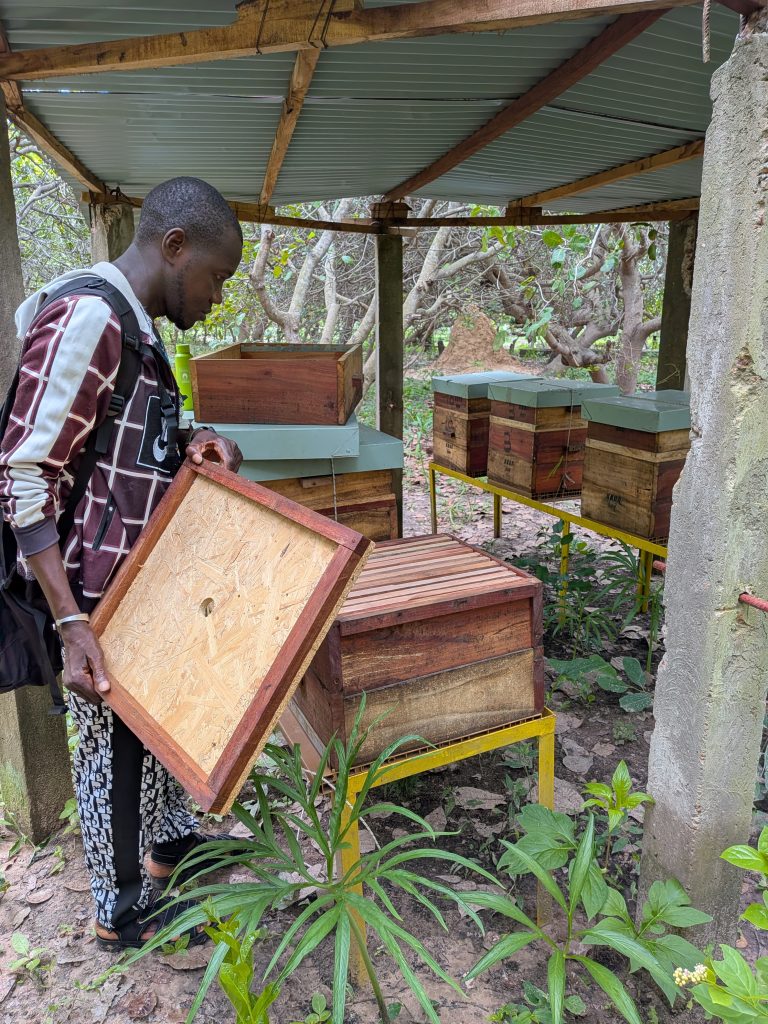
This is also the approach we considered most appropriate for Kankanba. Rather than buying queens or established colonies (which are not commercially available in The Gambia due to the lack of a developed queen-rearing and colony-breeding sector) for all the empty hives, the long-term objective was to encourage natural colonisation and reproduction. Empty hives can be prepared as attractive nesting sites, while strong colonies can eventually be divided when appropriate.
This approach requires patience. A farm with 150 hives does not necessarily have 150 productive colonies. What matters is the number and strength of established colonies, their development over time and the ability of the farm to maintain and multiply them.
Why Kenyan top-bar hives make sense in this context
One of the most important differences between beekeeping in Europe and in many parts of Africa is not simply the type of bee or hive, but the availability of equipment, inputs and technical services. A Dadant or Langstroth system can work very well in Africa, including with local bees, but it requires a whole set of equipment and supplies: standardised frames, wax foundation, wire, supers, extraction equipment and suitable storage. In areas where these items are expensive, difficult to import or simply unavailable, maintaining such a system can become a major constraint.
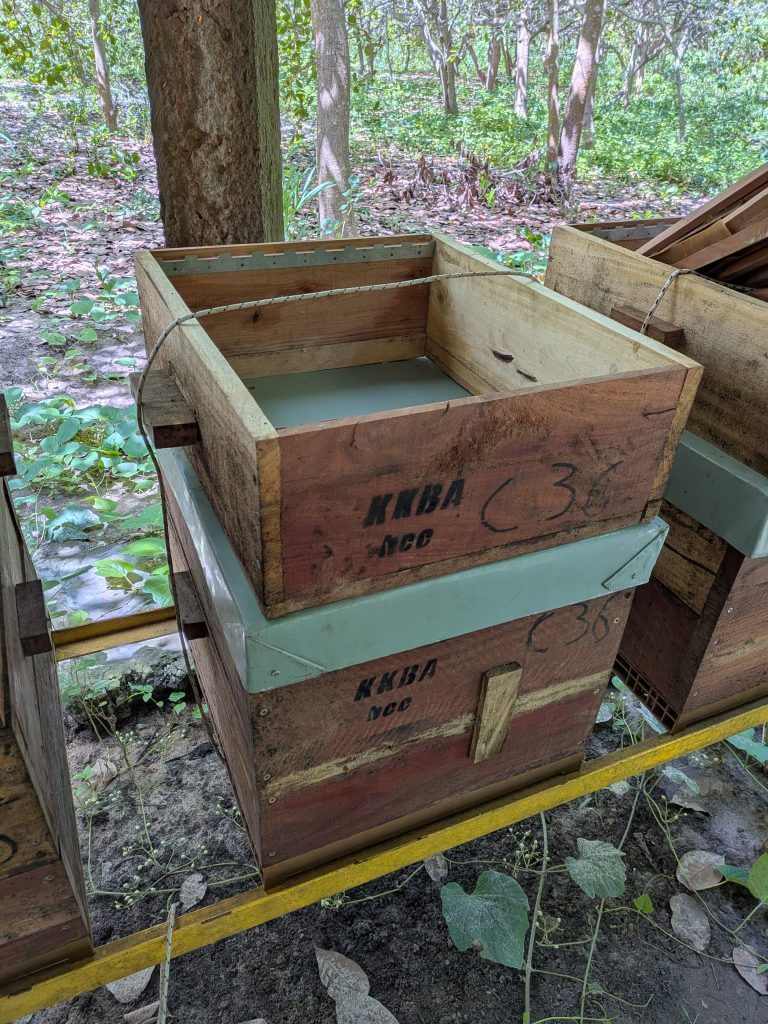
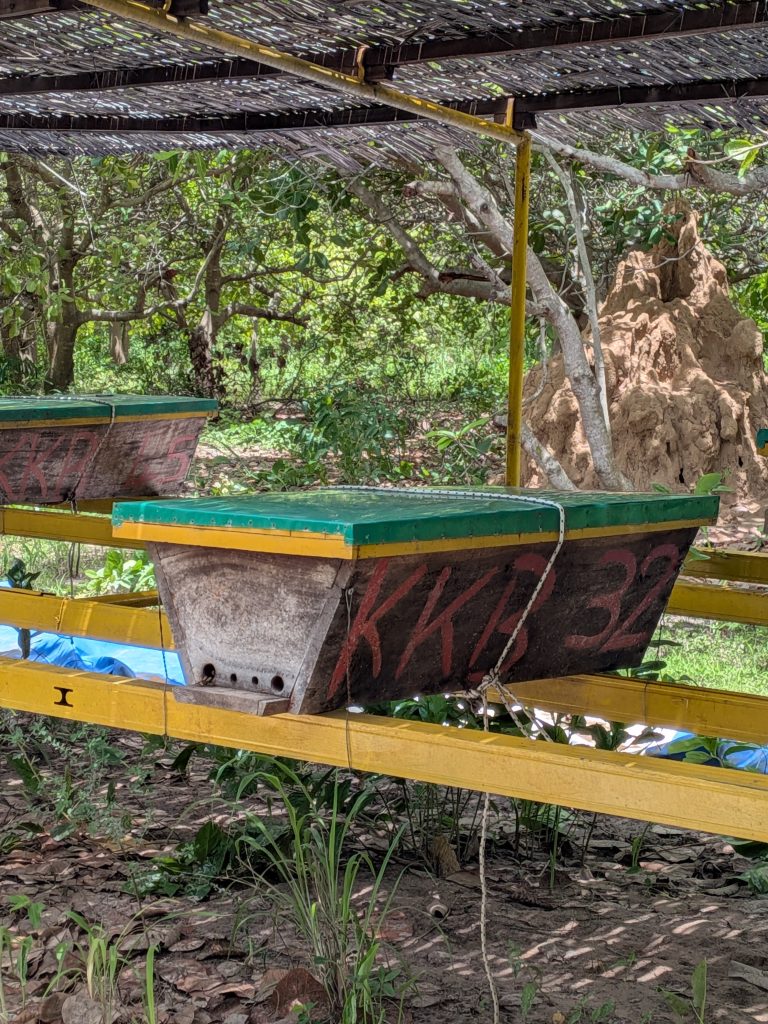
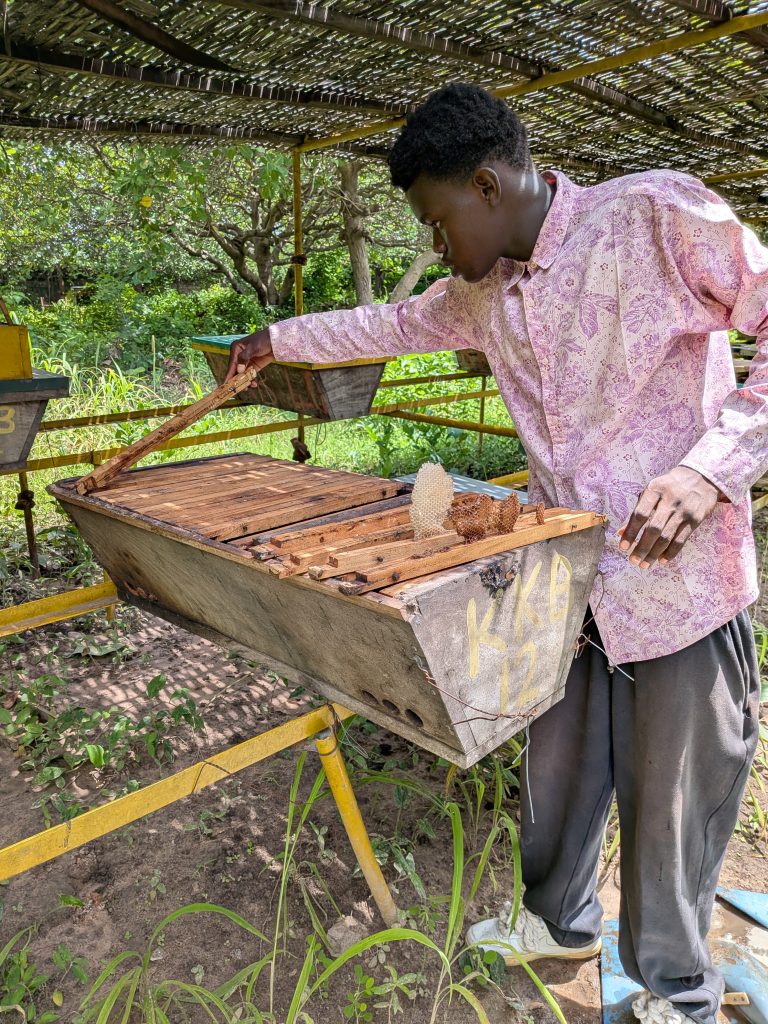
Kenyan top-bar hives offer a simpler alternative. They can be built locally using relatively basic materials and do not require standardised frames or large amounts of wax foundation. The bees build their own comb from simple top bars, usually with a small strip of wax to guide construction. This makes the system much less dependent on imported inputs and specialised equipment.
Harvesting is also simpler. Instead of removing honey from intact frames with a centrifugal extractor, the beekeeper can cut the honeycomb from the bars and crush or press it before filtering the honey. The comb does not need to be stored and returned to the hive after extraction. The bees simply rebuild it, although this requires additional energy and can reduce honey production compared with reusing intact comb.
This difference was particularly relevant at Kankanba. The farm already had 100 Dadant hives and 50 Kenyan top-bar hives, but the equipment and supplies needed to operate a conventional framed-hive system were limited. There were unwaxed frames and an old extractor, but no established system for supplying and storing waxed frames or managing the equipment as would typically be done in a European apiary. The Kenyan hives therefore offered a more practical system for developing the apiary with the resources actually available on the farm.
Top-bar hives also allow the beekeeper to work with natural comb construction and individual combs, which fits well with a strategy based on natural colony establishment and gradual development of the apiary. However, they are not automatically superior to framed hives. Once an apiary becomes larger and the necessary equipment, skills and supply chains are available, framed hives may offer important advantages for efficient honey production.
The choice of hive should therefore be based not only on the biology of the local bees, but also on what can realistically be built, maintained, repaired and operated locally. In many West African contexts, that can be just as important as the design of the hive itself.
Kankanba: adapting an existing apiary rather than starting from scratch
Our work at Kankanba Farm was essentially an exercise in adapting an existing apiary to the local context.
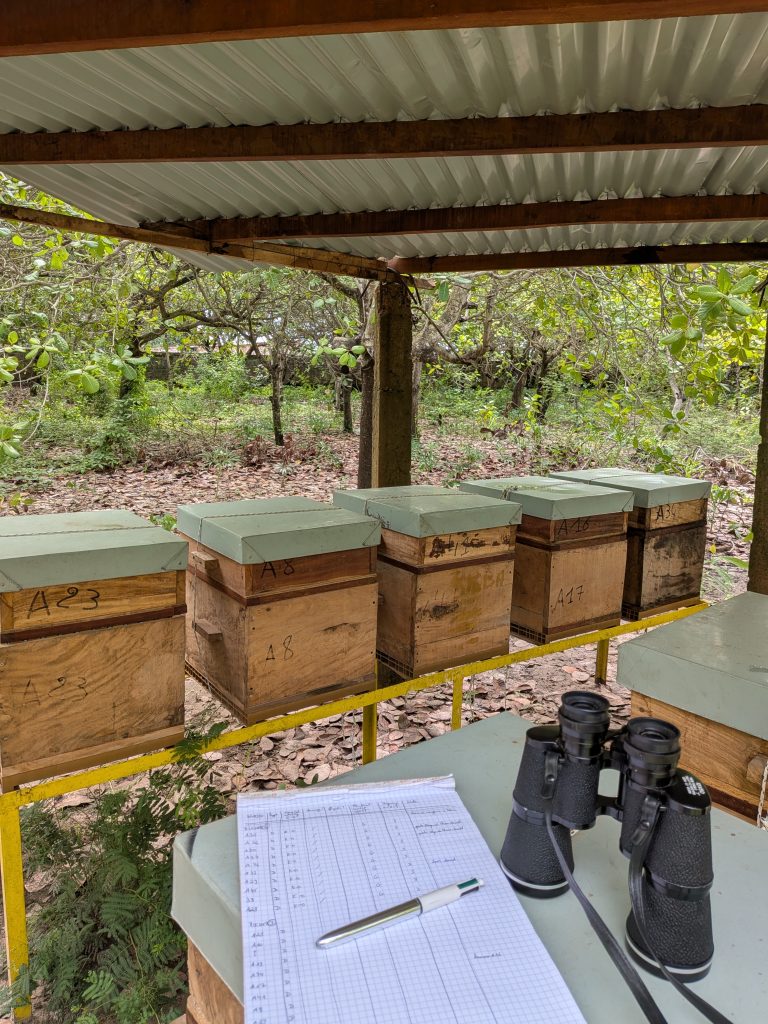
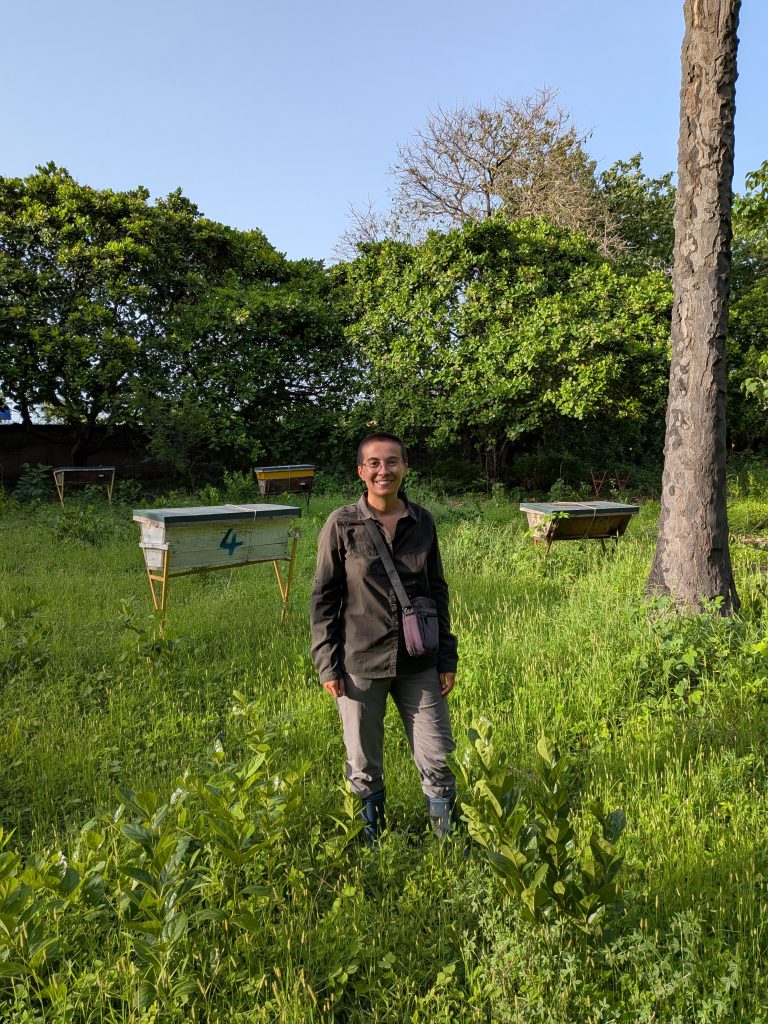
The farm had around 150 hives: 100 Dadant hives and 50 Kenyan top-bar hives. When we started assessing the apiary, only around 25 Kenyan hives were occupied.
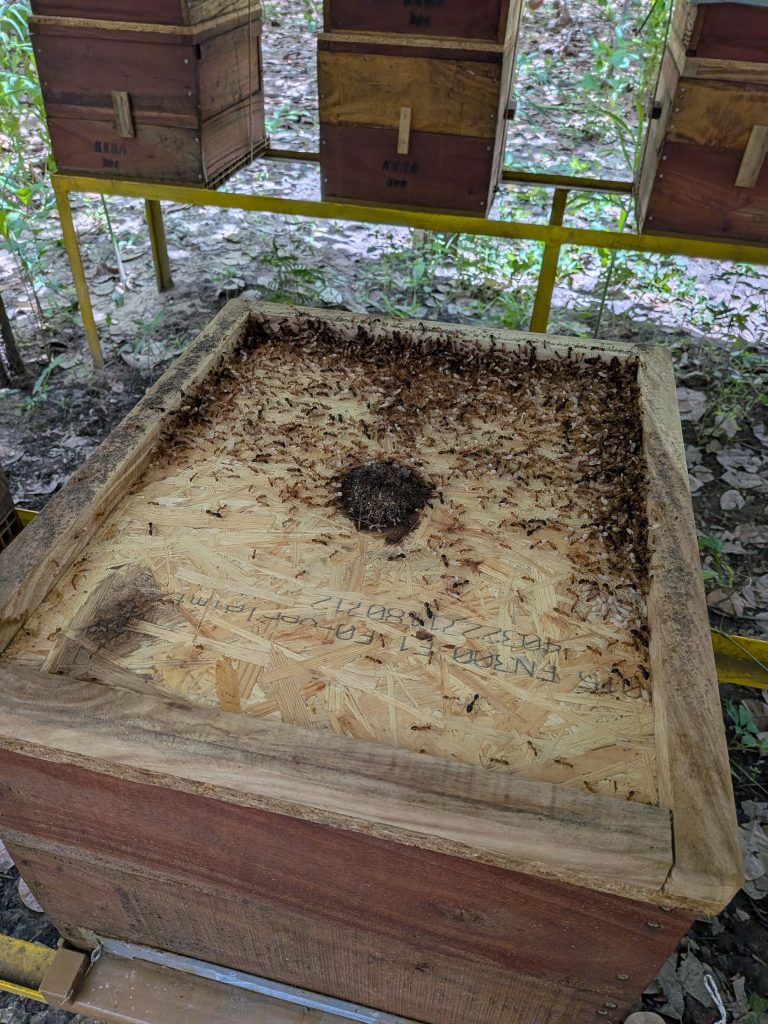
The first step was therefore to assess the existing apiary from outside the hives: identifying occupied and empty hives, estimating colony strength from external activity, and checking for damage, pests and other visible issues. Some Kenyan hives had been damaged or displaced, while squirrels had opened holes in some of them.
The Dadant hives presented another challenge. The equipment was available, but the management system had not yet been fully adapted to the local bees. The farm had Dadant supers and an old extractor, but no established routine for maintaining colonies, preparing equipment, storing combs or organising harvesting.
Our first work therefore focused on establishing the foundations of a management system: preparing hives for the upcoming dry season, improving the condition and positioning of the equipment, monitoring the occupied colonies and defining a realistic inspection schedule.
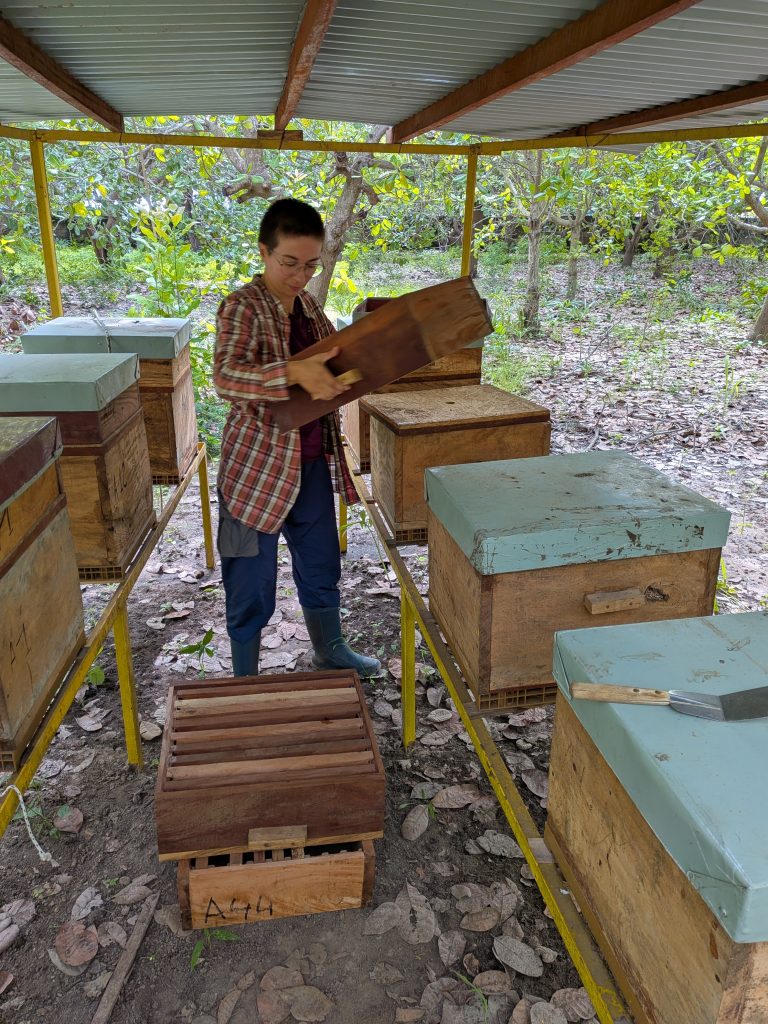
For the Dadant equipment, we considered a hybrid approach using the existing boxes but relying on locally appropriate management principles. In particular, strong colonies should be given additional space progressively rather than automatically receiving several supers. Where the equipment and management system make framed extraction impractical, the same basic principle as a top-bar hive can also be used: natural comb construction followed by crushing and pressing at harvest.
The objective was not to impose one perfect hive system, but to develop a system that the farm could actually operate with its available equipment, workforce and local bees.
Adapting honey harvesting to available equipment
The extraction method is another important difference.
With conventional framed hives, honey is commonly extracted using a centrifugal extractor. The comb remains intact and can be returned to the colony. This system can be highly efficient because the bees can immediately reuse the existing comb for storing honey instead of spending time and energy rebuilding it. However, it requires suitable frames, wired foundation, an extractor and a system for cleaning and storing the equipment.
With top-bar or fixed-comb systems, honey is often harvested by cutting the mature honeycomb from the bars. The comb is then crushed, strained or pressed to separate honey from wax. FAO describes several extraction techniques suitable for African beekeeping systems, including pressing and other low-cost methods.
This creates a different relationship with beeswax. Instead of trying to preserve every honeycomb for the next harvest, part of the comb is deliberately harvested and the bees rebuild it. The wax therefore becomes a valuable secondary product rather than simply a by-product.
The simplest system is not necessarily the least professional. It is the system that can be maintained consistently with the resources available.
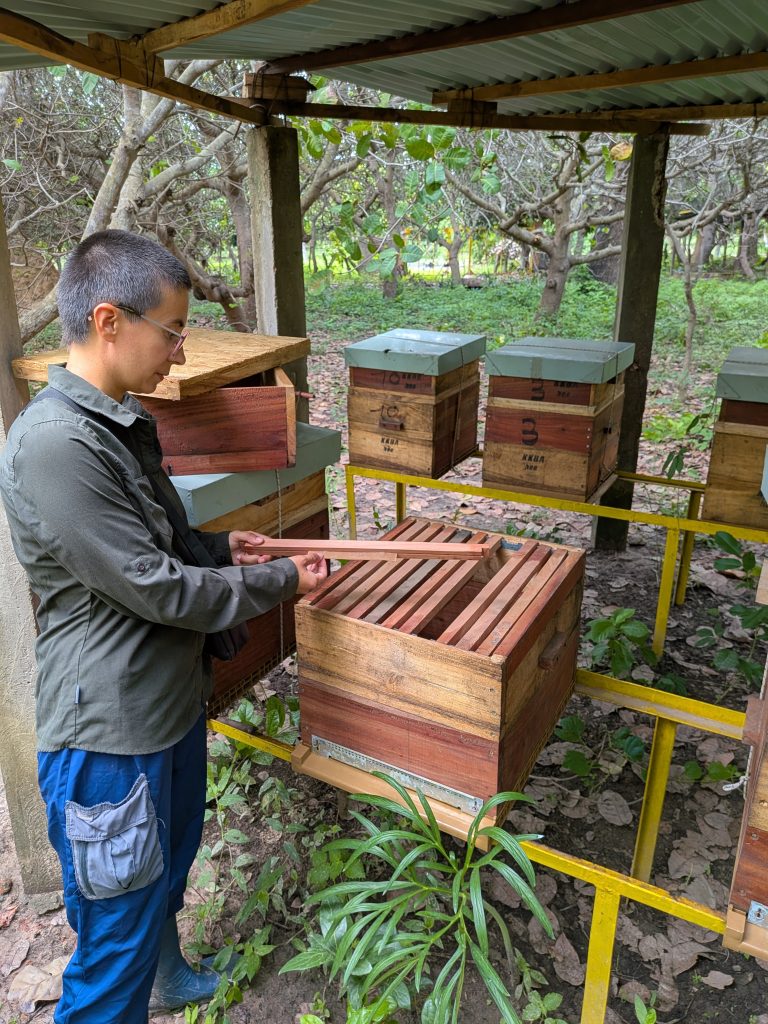
At Kankanba, the available Dadant frames were unwaxed, while wax foundation is not locally available. Rather than importing foundation, we decided to first test a hybrid approach: providing the frames with a small starter strip of wax and encouraging the bees to build complete, strong and well-aligned combs themselves. The best-built frames could then be used with the centrifugal extractor, allowing the farm to retain the main advantages of the Dadant system. Frames with weaker or poorly built combs, or honey that cannot be efficiently extracted this way, could instead be harvested by crushing and pressing. This approach allows us to test whether the Dadant equipment can be operated effectively with local resources, while keeping a simpler harvesting method as a practical alternative.
Training people is part of building the apiary
A successful farm apiary ultimately depends less on the consultant who establishes it than on the people who will look after it afterwards.
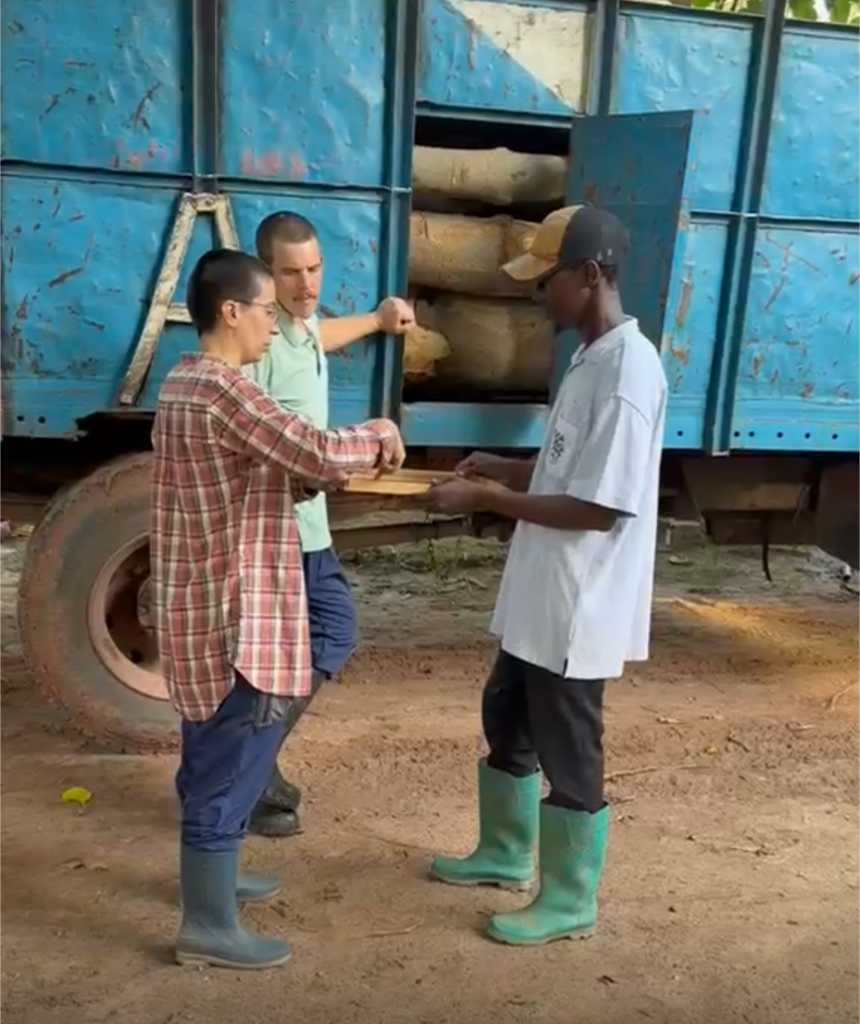
At Kankanba, part of our work was therefore to prepare a management framework that could be continued by the new farm manager and to train the farm workers in basic hive management.
The objective was therefore to provide the farm team with a clear understanding of how to manage the apiary according to the specific characteristics of the local bees, the two hive types and the resources available. This included explaining safe approaches to colonies, what to observe during inspections, when to add space, how management differs between Dadant and Kenyan top-bar hives, and which practices can realistically be applied using locally available equipment and materials.
This is particularly important with African bees. A management system that depends on a highly experienced beekeeper being present for every inspection is difficult to scale on a farm. The system needs to be simple enough for trained workers to perform routine tasks while recognising when a more experienced beekeeper is required.
Conclusion: an African apiary requires an African management strategy
There is no single “African beekeeping system”. Conditions vary enormously between the Sahel, the Sudanian savannah and the humid regions of the Gulf of Guinea. Flowering calendars, rainfall, hive traditions, bee populations and markets are different from one region to another.
There are nevertheless some common principles.
First, the colony follows the environment. The beekeeper should understand the local rainfall and flowering calendar before defining the production calendar.
Second, African honeybees should be managed according to their own behaviour. High defensiveness, frequent swarming and the possibility of absconding are not simply problems to eliminate; they are characteristics that influence how the apiary should be designed and operated.
Third, hive technology should match the local production system. Kenyan top-bar hives, traditional fixed-comb hives and modified framed hives can all be valid options. The important question is whether the system is compatible with the bees, the beekeeper’s skills, the available equipment and the intended market.
Finally, building an apiary is a long-term process. In a context where colonies can establish themselves naturally, multiplying strong colonies may be more valuable initially than maximising the first honey harvest.
Our experience at Kankanba reinforced this idea. The farm already had the physical infrastructure for a sizeable apiary. The challenge was to turn those empty boxes into a functioning production system adapted to local bees, local seasons and the people who would manage it.